
Production Forecasting Tools
Mr. Saad Ibrahim: P. Eng
Feb 25-26, Oct 12-13, 2026
Course Objective:
This course offers a detailed coverage of the industry recognized techniques used to generate production forecasts for oil and gas wells using the applicable techniques; well testing (PTA), Rate Transient Analysis (RTA) and Decline Curve Analysis (DCA). Production forecasting can be more reliable with the knowledge of the OOIP and OGIP; except for DCA, which is achieved using the P/Z plot and PTA for conventional reservoirs. For unconventional reservoirs RTA is utilized using techniques such as the flowing material balance, Rate normalized and type curve methods. Forecasting can readily be performed using Arps decline analysis for conventional reserves (old method) but for the unconventional reservoirs several techniques including: Power Law, Modified Hyperbolic methods. Well Typing is discussed for well with short history but with of offset wells with long history to generate well forecasts. Pressure history matching using either RTA and PTA can allow reliable production forecasts to be generated, which requires both production and pressure data, and also can perform sensitivity analysis for (P90, P50, and P10 cases) using deterministic and probabilistic methods. Other techniques will be discussed for mature waterflood projects using a unique imperial method. Numerous case studies will be presented using both analytical and numerical methods. A course hand-out which is an excellent reference will be provided.
Who Should Attend:
This course is aimed at reservoir, petroleum and exploitation engineers/technologists, geophysicists, and geologists who are involved in reserves determination and production forecasting.
Course Instructor:
 Mr. Saad Ibrahim, P. Eng. – president of Petro Management Group Ltd. Mr. Ibrahim has over 35 years of diversified experience in the oil and gas industry and is known as highly recognized consultant and a distinguished instructor. He completed a post-graduate program with the University. The focus of Mr. Ibrahim’s experience lies in the area of reservoir management, reserves estimate, EOR, and well test planning/analysis. Mr. Ibrahim is a member of APEGA and SPE.
Course Agenda:
Description of the flow regimes and the use of Darcy equation
Estimate of hydrocarbons-in-place using well test analysis techniques (PTA):
-
Review basic concepts of reservoir evaluation, such as flow geometry and boundary conditions.
-
Flow regime diagnoses using PTA methods (Log-log plots of pressure vs time and for production rate vs time).
-
Review of the principles and applications of the well test analysis techniques for to estimate hydrocarbons-in-place; including:
-
Reservoir Limit Tests (RLT) – case studies
-
Deconvolution techniques – case study
-
Estimate of the hydrocarbons-in-place production forecasts using both the deterministic and probabilistic methods:
-
Volumetric, static material balance methods (oil and gas), methods (class example)
-
Probabilistic method using Monte Carlo simulation
-
Use of Rate Transient Analysis (RTA) including the use of flowing material balance technique and advanced type curve matching (Blasingame, Fetkovich)
-
Use of history matching techniques of production/pressure data
-
Use of new numerical techniques to estimate Stimulated Reservoir Volume (SRV), Contacted Reservoir Volume (CRV) and forecasting, commonly used for reserves booking of Multi-stage Frac of Horizontal wells (MFHW’s).
-
Numerous case studies
Decline Curve Analysis (DCA)
-
The use of ARPS decline curve analysis, applications and deficiencies, (class example)
-
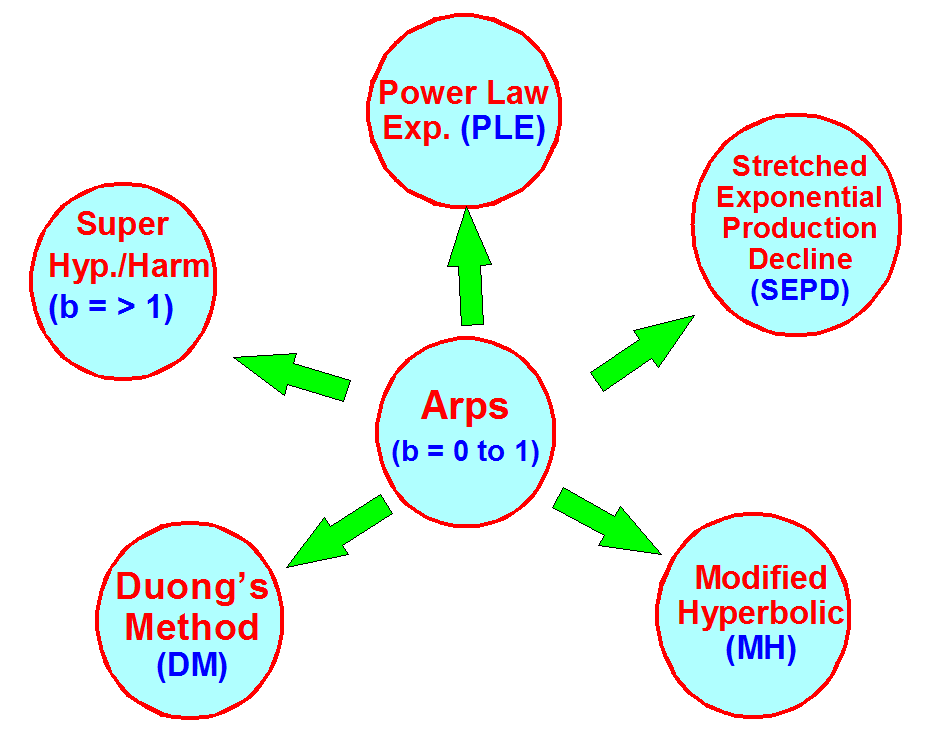
The use of new DCA methods and its application for unconventional wells that are not stabilized (still in transient), including the methods in the graph below:
-
The use of well typingis discussed to generate production forecasts (P90, P50, and P10 cases).
-
A unique empirical (Russian method !) used to estimate recoverable oil and production forecasts for mature waterflood projects – Case studies
-
Production forecast for gas wells using the Modified Isochronal test is presented.
Closing remarks and a question period
Live Online:
$2,400.00 plus 5% (GST)

A new payment method is available: E-Transfer to accounting@petromgt.com
In the note to the payment enter the name of the course and personal information.
This course is aimed at reservoir, petroleum and exploitation engineers/technologists, and geologists who are involved in the area of Waterflooding and EOR schemes.
 Mr. Saad Ibrahim, P. Eng, president of Petro Management Group Ltd.Withover 35 years of diversified experience in the oil and gas industry. He is a worldwide highly recognized engineering consultant and a distinguishedinstructor (Please see his professional profile).Mr. Ibrahim is a member ofAPEGA and SPE.
Live Online:
Cost: 1600 (+ 5% GST)
On-demand (Recorded):
Cost: Full Course $1200 (+ 5% GST)
Download Full Fee Schedule (PDF)
Waterflood Management
“Only pay for what you need!!”
For the on-demans online option, please make your selection of your choice:
- Attend the full course (all sections) for only $1,000.0 + GST (which is 20% off)
- Select the requested section(s), and add up the fee of each section +GST
Online course agenda:
Section 1: Introduction to Waterflooding and E.O.R
(Duration 34 minutes) Fee: $60.0
- History waterflood and EOR worldwide
- How EOR Schemes Affect oil recovery
- Rock and fluid characteristics of various waterflood and EOR schemes
Section 2: Reservoir Characterization
(Duration: 2 hrs. 30 minutes) Fee: $180.0
- Geophysical, geological, and petrophysical definitions (Case study)
- Impact of Depositional Environments on reservoir geometry and quality
- Rock and fluid properties (Case study)
- Integration of static & dynamic data into reservoir modeling
Section 3: Reservoir Drives and Reserves Estimate
(Duration: 2 hrs. 22 minutes) Fee: $170.0
- Review of various reservoir drives and characteristics (Case study)
- Volumetric and material balance calculations (Case study) and (Class problem)
- Probabilistic and statistical methods
- Reservoir Limit Test application to evaluate feasibility of waterflood (Case study)
Section 4: Waterflood planning and Design
(Duration: 6 hrs & 08 minutes) Fee: $480.0
- Factors that impact waterflood performance
- Design steps of waterflood and EOR
- Screening process of waterflood and EOR projects
- Application of low salinity waterflood (LSW)
- Design details of waterflood pilot project (Case study)
- Design optimization of waterflood using Hz well with multi-stage frac (Case study)
- How to reduce water break-through in MFWH’s
- Planning water injection requirement and control (Case studies)
- Waterflood stages and duration (Class problem)
- Methods to predict EUR, including:
-
- Empirical Method (Case study)
- Buckley and Leverett displacement mechanism
- Weldge Method, after water break-through (Class problem)
- Stiles Methods for layered reservoir (Class problem)
- Dykastra -Parsons Method for Heterogeneous Reservoirs (Class problem)
- Numerical modeling of waterflood, use of software (Case study)
Section 5: Performance Monitoring of Waterflood Projects
(Duration 3 hrs) Fee: $240.0
- Evaluation of reservoir sweep efficiencies.
- Pattern injection balancing at different stages of waterflood.
- Advantages and disadvantages of analytical and numerical monitoring techniques, including:
- Conformance plots (Class problem)
- Voidage Replacement Ratio (VRR)
- Water quality and water filter size determination
- WOR vs cumulative oil applications (Class problem)
- Hall Plot (Class problem)
- Tracer surveys
- Ferrier Cardium Unit #3, performance evaluation (Class exercise)
- Unique water injection problem (Case study)
- Performance Comparison of waterflood projects worldwide
Section 6: Operation Problems
(Duration: 1 hrs 20 minutes) Fee: $120.0
- How to diagnose production problems and prepare remedial action
- Packer seal-off test (Class Quiz)
- Early water production and break-through
- Scale and corrosion problems
- Clay swelling and fine migration